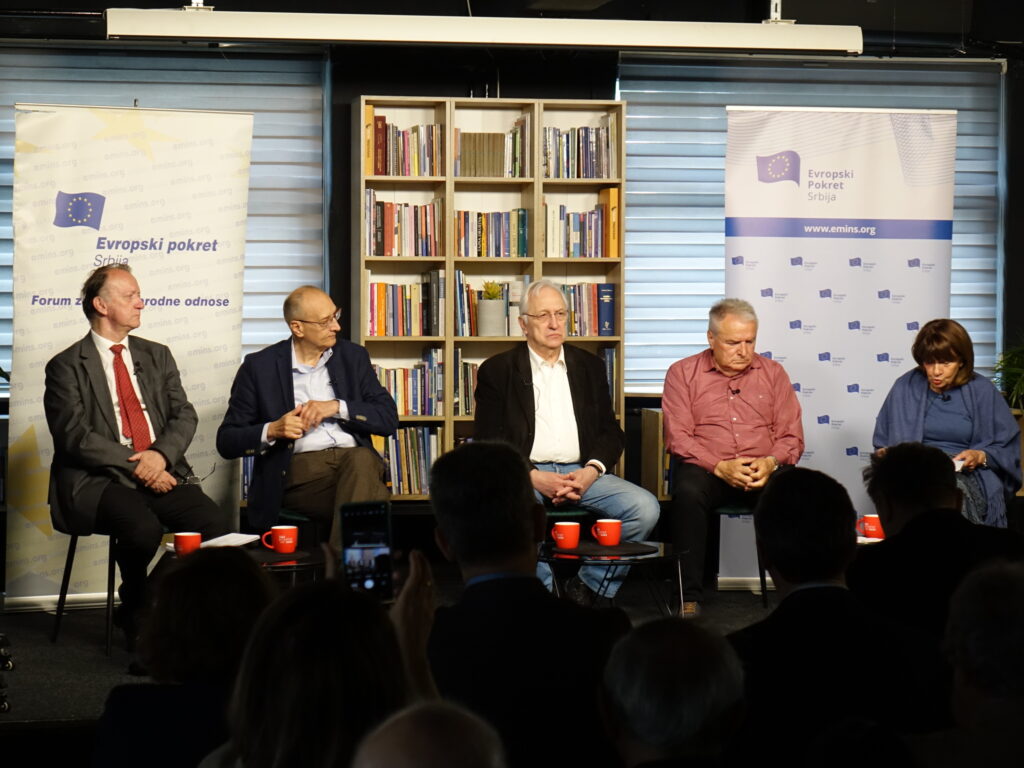
On Thursday, May 29, 2025, the Forum for International Relations of the European Movement in Serbia organized an open debate on the topic “Resetting Serbia’s Foreign Policy and Diplomacy.” The discussion brought together distinguished experts and former diplomats: Ivan Vujačić, Jelica Minić, Srećko Đukić, Miomir Udovički, Dragana Filipović, Dragana Đurica, Dragan Đukanović, and Duško Lopandić. Below you can read the conclusions of the debate, which have been adopted as the official positions of the Forum for International Relations. A debate on resetting Serbia’s foreign policy and diplomacy was held as a part of broader initiative of the European Movement in Serbia, entitled “Resetting the Republic,” within the context of country’s deep socio-political crisis and in anticipation of requested, expected, and prepared political changes.
Following conclusions present a basis for further debate, intended to involve other societal actors, such as civil society organizations, think tanks, political parties, activists, experts, students, and others, with the goal of preparing a foreign policy strategy for Serbia in the period following the change of the current regime.
Multi-variant policy of “sitting on multiple chairs”, or policy of false “all-alignment”, has neither produced long-term results nor is fundamentally sustainable in the face of growing international confrontation among major powers. Serbia’s EU accession process has fallen into a dead-end, as well as its neighbourhood policy that has turned into a policy of discord. Through its “neutrality plus” approach, entailing distancing from NATO and misaligned foreign policy with the EU, Serbia has become a lone island in the Balkans. Despite continuously declaring that “Serbia is on the European path,” the ruling circles have in practice abandoned EU integration, perceiving it as a threat to their hold on power.
Serbia’s new foreign policy must decisively focus on accelerated conclusion of EU accession negotiations and on new regional initiatives aimed at improving regional climate and repairing or improving good neighbourly relations.
European Integration
Revitalization of pro-European policy should be at the core of Serbia’s reset foreign policy, directed at rehabilitating European idea within the country and fostering the broadest possible consensus on the one hand, and expediting completion of EU accession negotiations on the other. Basic prerequisites for such outcome are clear political will, a time-bound roadmap, and budgetary support for strengthening institutions and human capacities, along with broad public mobilization.
Serbia is a European country that shares the fate of its neighbourhood and of Europe as a whole, and shares “European values and principles,” as stated in the first article of the Constitution of the Republic of Serbia. Realization of Serbia’s multiple political, economic, security, and societal interests is linked to attaining EU membership.
In the context of rapid geopolitical changes in Europe as well as globally, the conclusion of EU accession negotiations requires urgent reassessment and reform concerning issues that led to the current halt in European integration:
- Fulfilment of the “first Copenhagen criterion” (democratic institutions and rule of law) – in particular, this entails implementation of obligations stemming from Chapters 23 and 24 (meeting interim benchmarks for both chapters), as well as ensuring judicial independence in practice;
- Alignment of steps and measures in foreign policy with the EU’s Common Foreign and Security Policy (CFSP) and the Common Security and Defence Policy (CSDP). This includes alignment with EU’s measures toward Russia;
- Renewal of the Belgrade–Pristina dialogue, based on previously agreed and partially implemented arrangements, aiming at full normalization of relations, including absolute respect for the rights of Serbian community in Kosovo.
Domestically, a clear media campaign should be launched to inform and explain to citizens the role and significance of the EU for Serbia’s economic and international position. European integration process has been a matter of societal consensus in all countries that have joined the EU, and this consensus should be rebuilt.
A new policy toward the EU should also include a dedicated strategy to promote the image of a democratic and pro-European Serbia abroad, building on the example set by student cyclists and marathon runners who visited Council of Europe and EU institutions in Strasbourg and Brussels.
Relations with Neighbours
Implementing a genuinely pro-European policy will create the conditions to begin resolving numerous outstanding issues and strengthening cooperation with neighbours.
A multitude of unresolved problems, especially with neighbours that emerged from the breakup of former Yugoslavia, continues to dominate regional relations. Without resolving accumulated issues with its neighbours in the Western Balkans and Southeast Europe, Serbia will remain isolated.
Reaffirming a strengthened pro-European policy will strengthen the will of political elites, both in Serbia and neighbouring countries, to start resolving long-standing issues, especially with Croatia, Bosnia and Herzegovina, and Montenegro. Furthermore, it would also contribute to accelerating normalization between Belgrade and Pristina and implementing numerous agreements reached since 2011. The European Union will insist on resolving bilateral issues before considering new enlargements; thus, this may be crucial for Serbia to align with its immediate neighbourhood and integrate into its broader European surroundings.
- In view of these objectives, Serbia should make full use of all forms and instruments of regional multilateral cooperation, such as Berlin Process, Regional Cooperation Council (RCC), SEECP, CEFTA, and others. New initiatives should be considered based on inclusiveness and aimed at enhancing security and eliminating fear in the region;
- Priority should be given to renewing and intensifying efforts to resolve all open issues with the “new neighbours,” primarily Bosnia and Herzegovina and Croatia. The most urgent issues concern legacy of war (undefined borders, treatment of “new” minorities, completion of SFRY property succession, addressing issues of missing and displaced persons, and prosecuting war crimes in the post-Yugoslav area);
- Serbia’s imbalanced relations with Central Europe (from Hungary and Slovakia on one end to Poland and the Czech Republic on the other) must be realigned. Serbia should also strengthen ties with its eastern neighbours (Romania and Bulgaria) and, in a broader context, with Greece, Italy, and Austria as neighbours of former Yugoslavia. Closer cooperation with these EU member states will also improve Serbia’s international position. It is especially important to avoid potential blockages from Croatia, Romania, and Bulgaria in the final phase of EU accession negotiations;
- Instead of promoting a “Serbian World” policy, Serbia should reaffirm a policy of improving good neighbourly relations, where care for Serbs outside Serbia would have a natural and non-confrontational role. Position of Serbs in neighbouring countries should not rest on paternalism but on reaffirming their status through integration into political life of neighbouring countries.
Relations with Great Powers
Abandoning policy of “four pillars” and false concept of “all-alignment” does not mean neglecting cooperation with globally important countries that influence in various ways Serbia’s international position and economic development.
Serbia cannot ignore the United States, which, due to the Trump administration’s policies, no longer act as a promoter of EU integration. Serbia’s interest in good relations with the US stems precisely from its role as the main pillar of NATO and as the world’s most powerful country. This is also related to peacekeeping in Kosovo and still significant U.S. influence on the Albanian side and its political elite. Serbia must conduct a highly nuanced policy towards the U.S. so that its ties with and China do not become an even more serious point of contention. Preserving EU integration process would mean maintaining distance from the U.S. in those areas where strong EU-U.S. disagreement exists. Any deepening of U.S. ties must not come at the expense of Serbia’s core priorities.
Resetting relations with Russia should consider historical, cultural, and other ties between two countries and Russia’s status in the UN in the context of the Kosovo issue. On the other hand, Serbia–Russia official relations are non-transparent, burdened with propaganda, irrationalities, and filled with fetishization, stereotypes, and exaggerated emphasis on spiritual ties. Current uncritical narrative of “eternal friendship” ignores numerous historical examples when Serbia’s interests were completely disregarded by Moscow or directly opposed to those of the Russian (SSSR) empire. Moscow’s recent support for Vučić’s regime in the fight against the so-called “coloured revolution” shows the extent of opposition of long-term interests of Serbian society to the policies of Russian ruling class.
Distancing from excessive Russian influence and reducing ties to a normal state-to-state level should include issues such as energy, military-technical cooperation, and Russian media propaganda in Serbia. The first step towards liberating Serbia from excessive Russian dependency concerns sustainable energy security, independence, and integration into the European gas and oil network. Future development of Serbia’s nuclear energy program is also of long-term importance.
Serbia must not neglect cooperation with China, which in the 21st century plays a key international role in politics, economics, and technology. China is a global superpower in trade and other areas, and it is completely normal to develop good and beneficial relations with it – as other countries, including EU member states, do. Serbian government should “reset” its approach to Chinese companies that do not fully comply with labour and environmental regulations and must stop concluding non-transparent state agreements and loans that have been a major driver of high corruption. Serbian authorities must demand that Chinese firms operating in Serbia strictly adhere to domestic laws and contractual obligations.
Reaffirming Serbia’s Interests Through Multilateral Diplomacy
Changes in global political and security scene are leading to erosion of the role of international organizations and attempts to redefine/reform them in response to various challenges.
- Serbia should actively participate in initiatives that respond to global challenges and define new operational priorities for these organizations;
- EU institutions and regional organizations are especially important, where Serbia must conduct foreign policy through constructive diplomatic engagement and cooperation to protect its international position and reputation;
- Serbia must strengthen its regional presence and joint engagement, by taking a more proactive role in implementing the Common Regional Market initiative and enhancing cooperation within concrete activities and projects of shared interest;
- Serbia’s representations to international organizations must have trained staff at all levels with experience in multilateral diplomacy. Otherwise, the country’s interests may be compromised in international forums.
Reaffirmation of Public and Particularly Economic Diplomacy
Resetting foreign policy also involves reaffirming transparent public diplomacy with an increased focus on economic diplomacy, which should serve not only to attract foreign investment but also to strengthen and internationalize the domestic economy. Well-designed public diplomacy requires internal public debates and consensus-building on goals, tools, and methods to achieve well-coordinated and effective outcomes. This requires involvement of research, academic, and cultural institutions, business community, and the media.
Serbia needs a clear long-term strategy for promoting its foreign economic priorities, which defines goals, target markets, sectors, and ways to measure success of its economic diplomacy.
- Serbia should identify several priority sectors in which it has the greatest potential and focuses its economic diplomacy accordingly. Instead of spreading its resources thin, it should develop branded sectors (such as Serbian organic food, IT services, or auto parts, and/or others) by working closely with businesses;
- Serbia should develop a modern and recognizable brand internationally that emphasizes its economic strengths. Culture and business should be promoted together, through events such as “Serbian Weeks” abroad and through active presence on digital platforms;
- Serbian diaspora represents an important, yet underutilized, resource for economic promotion. A dedicated national cooperation plan with diaspora should be adopted, along with a revised approach to cyclical economic migration.
Institutional and Personnel Measures for Resetting Serbian Diplomacy
For over a decade, the Ministry of Foreign Affairs (MFA) of Serbia has been an institution captured by party interests, nepotism, and disregard for professionalism in serving the country’s foreign policy objectives. Therefore, reset of diplomacy requires radical measures of lustration and thorough reform of the institution itself, with full respect for legal regulations and a return to professionalism and meritocracy as foundational criteria.
This entails:
- Within a reformed new MFA, preparing a Foreign Policy Strategy aligned with Serbia’s future EU membership;
- Establishing effective coordination (horizontal and vertical). In addition to horizontal coordination between relevant domestic institutions and actors, vertical coordination must be strengthened – from the headquarters to embassies. This means having clear instructions, regular communication, and exchange of best practices among embassies;
- Preparing a new systematization for Serbia’s MFA – which means rationalizing its organizational structure, adopting a new operating model tailored to the real needs (modernizing operations, especially in communications, digitalization, and analytics), and reassessing the need for the current number of diplomatic-consular missions and total staff;
- Enacting a new Law on Foreign Affairs that introduces competitive recruitment and clear criteria for selecting professional staff.