EU Decision-Making Process
Organised by: European Movement in Serbia (EMinS) in cooperation with Europe House and EU Delegation in Serbia
For: Students and young professionals from across Serbia
What is it about?
🔹Are you curious how the European Union really makes decisions?
🔹Who negotiates, who compromises, who blocks, and why?
🔹What actually happens between European Commission, European Parliament, EU Council, media, and interest groups when a law is developed and adopted?
🔹Do you want to experience EU negotiations from the inside, not just read about them?
🔹Would you like to be considered for an award – study trip to the EU institutions in Brussels?
Why apply? What’s in it for you?
🔹Understand how the EU really works
🔹Build drafting & public speaking skills
🔹Practice real negotiations, not theory
🔹Experience media and interest-group pressure
🔹Strengthen critical thinking & debate skills
🔹Join a network of engaged young Europeans in Serbia
🔹Receive an official participation certificate
🔹Possibility of being awarded a Brussels study visit
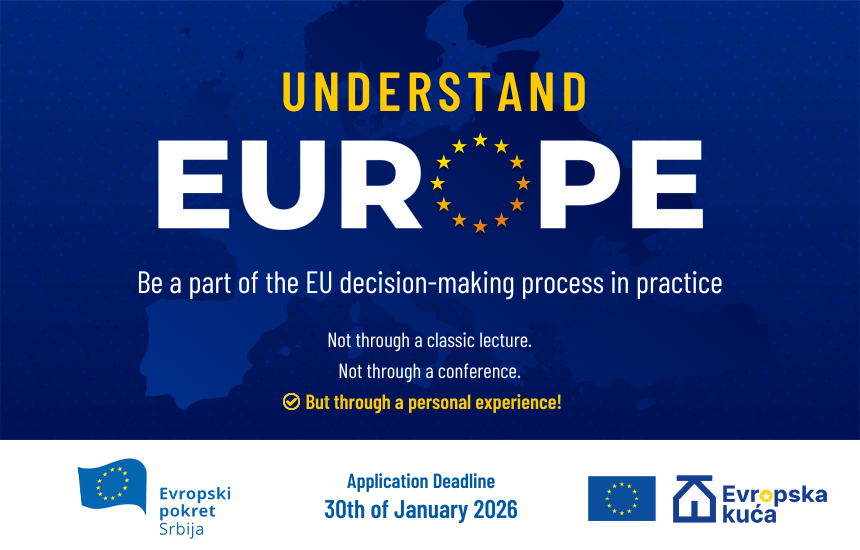
European Movement in Serbia (EMinS) invites students and young professionals from across Serbia to apply for an intensive and realistic EU Simulation Game, taking place in March and April 2026, with support of the Europe House and EU Delegation in Serbia.
At a time of growing misinformation, euroscepticism and political distrust among young people, this Simulation Game offers something different: direct experience, informed debate, and practical understanding of how the EU actually works, and why it matters for Serbia.
Why this programme?
The EU Simulation Game – Understanding the EU Decision-Making Process is an intensive, practice-oriented programme designed to give young people in Serbia a realistic, inside view of how EU decisions are made. This is not a conventional lecture course and not a theoretical exercise. It is a hands-on simulation of the EU ordinary legislative procedure, with strong mentoring support from high-level experts with experience in working with EU-institutions, where participants assume real institutional roles, negotiate under pressure, draft legal and political texts, communicate with the media, and experience the dynamics of compromise, power and responsibility.
What do participants gain?
By taking part in the Simulation Game, participants will:
- gain practical, insider understanding of EU decision-making,
- develop skills in negotiation, drafting, public speaking and coalition-building,
- learn how media and interest groups influence political outcomes,
- strengthen analytical thinking and democratic debate skills,
- become part of a network of active, informed young Europeans in Serbia,
- receive a certificate of participation.
In addition, outstanding participants will be recognised through awards, and the programme foresees a study visit to EU institutions in Brussels for selected awardees.
What does the programme look like?
The Simulation Game will take place over five intensive weekends, between March and April 2026, with mandatory participation and obligation to attend all in-person sessions in Belgrade and online/hybrid weekends in the following format:
- Weekend 1 (6-8 March 2026): Foundations and role assignment (in person, at the Europe House Belgrade)
- Weekend 2 (13-15 March 2026): EP & Council Work (online/hybrid/ those wishing to join in person may do so at the EMinS classroom)
- Weekend 3 (27-29 March 2026): First Trilogues (online/hybrid/ those wishing to join in person may do so at the EMinS classroom)
- Weekend 4 (17-19 April 2026): Second Trilogues and Crisis Scenario (online/hybrid/ those wishing to join in person may do so at the EMinS classroom)
- Weekend 5 (23-26 April 2026): Final Agreement, public presentation, and presentation of awards (in person, Europe House Belgrade)
Throughout the programme, participants will work on one concrete EU legislative file, following it from the initial European Commission proposal all the way to a final negotiated legislative act. Each weekend represents a different stage of the EU decision-making process, mirroring institutional reality.
Participants will be assigned to institutional and actor roles, including:
- European Commission
- European Parliament
- Council of the European Union
- Media
- Interest groups / lobbyists
The simulation is designed and guided by experienced practitioners and academics, including experts with long-standing experience in EU institutions and advanced EU simulation games.
Working language will be English for the major oart of the simulation will, with a possibility for internal negotiations to be performed in Serbian. However, training courses and all public presentations will be done in English, as well as the preparation of the legislative act.
Organisational costs for the simulation are covered. Travel and accommodation for participants outside Belgrade will be covered for in-person weekends.
Who can apply?
This call is open to motivated and committed young people from all parts of Serbia, regardless of prior experience with EU topics.
You are eligible to apply if you:
- are a BA or MA student, or a young professional;
- are typically between 18 and 30 years of age;
- are currently studying or working in fields such as (but not limited to):
law, economics, political science, international relations, public policy, journalism, European studies, sociology, humanities, STEM or other related disciplines; - have excellent command of English language (oral and written);
- are available to take upon the obligation to participate in all five simulation weekends;
- have a strong interest in European affairs, democratic governance, public policy or political communication;
- are willing to actively participate, negotiate, draft texts and work in teams.
What we are looking for:
Selection of participants will be merit-based, transparent and inclusive, and will aim to create a diverse and balanced group that reflects the complexity of real EU decision-making.
In the selection process, particular attention will be given to:
- motivation and interest in EU affairs and public policy,
- ability to express ideas clearly (in writing and orally in English language),
- readiness to work intensively and collaboratively under time pressure,
- openness to different perspectives and willingness to engage in compromise,
- commitment to attend the entire programme,
- gender balance,
- balanced representation from across Serbia,
- disciplinary diversity and inclusion of applicants from different academic and professional backgrounds.
How does the selection process work?
The selection process consists of four stages:
- Public call and application submission (30th of January 2026): Applicants submit an online application form including basic personal information and motivation questions.
- Structured evaluation of applications (1st half of February 2026): All applications are assessed using a predefined scoring grid that evaluates motivation, clarity of expression, relevance of background, and commitment.
- Mandatory interviews (second half of February 2026): Shortlisted candidates will be invited to an interview (online), which is a mandatory part of the process. Interviews are used to:
- confirm availability and motivation,
- assess communication and argumentation skills,
- help determine the most suitable institutional role for each participant,
- ensure balanced group dynamics.
- Final selection (end of February 2026): Final list of participants is composed to ensure diversity, balance and institutional realism. All applicants will be informed via email on the outcome of the selection process.
How to apply?
Your application must contain the following:
- completed application form enclosed to this Call (all elements of the form are mandatory to be completed in English language); Download application form here
- short bio in English language (up to 1 page, in Word or PDF format);
- cover letter in English language.
Applications must be sent via email only: EUsimulation@emins.org Application email must contain the subject line: “Application to the EU Simulation Game in Serbia 2026.”
Application deadline: 30th of January 2026
Only complete applications submitted by the deadline will be considered.
For any questions and/or clarifications, please contact us via email: EUsimulation@emins.org until 10th of January the latest.
Important note:
This simulation game is demanding. It requires time, commitment and active engagement. But it is also an opportunity to experience EU decision-making as it really is: complex, political, imperfect, and deeply relevant.
If you want to move beyond slogans and actually understand how Europe works, this programme is for you.
We strongly encourage applications from all parts of Serbia.