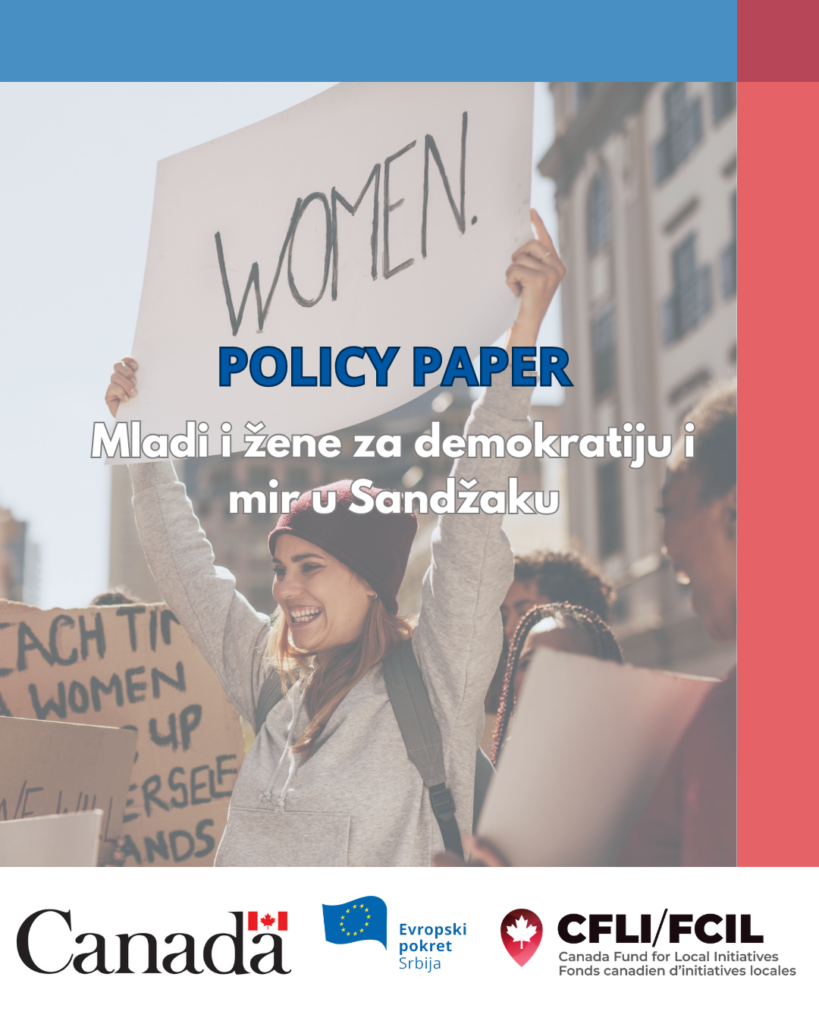
The European Movement in Serbia has published the policy paper “Young People and Women as Active Participants in Democracy, Peace and Tolerance in Sandžak,” prepared within the project “SPARK SANDŽAK – Youth and Women for Democracy and Peace,” implemented by the European Movement in Serbia with the support of the Embassy of Canada in Serbia through the Canada Fund for Local Initiatives (CFLI). The policy paper examines the relationship between democracy, peace, and tolerance in Sandžak through the position of young people and women, starting from the premise that the experiences of these social groups most clearly reveal the extent to which democratic values and institutional mechanisms are truly accessible in everyday life. The document shows that young people and women in Sandžak are neither passive nor uninterested in public life, but that there is a clear willingness to participate, show solidarity, and contribute to social change. At the same time, such participation remains constrained by weak institutional responsiveness, insufficient information about rights and opportunities, distrust in institutions, legal insecurity, economic pressures, and the sense that public engagement often fails to produce visible results.
The policy paper further points out that peace and tolerance in Sandžak are, to a significant extent, maintained through everyday coexistence, informal ties, habits of tolerance, and social pragmatism, but that this foundation remains fragile unless accompanied by inclusive, legitimate, and functional institutional frameworks. In this regard, the document does not portray Sandžak as a space of open conflict, but rather as an environment marked by a persistent gap between formally declared democratic norms and the actual experience of citizens’ participation in public life.
Special emphasis is placed on the position of young women, who face additional barriers due to insufficient institutional support, conservative social expectations, and limited visibility in the public and civic sphere, despite the fact that their participation is of key importance for sustainable democratization processes and peacebuilding.
The policy paper also stresses that issues of peace, democracy, and tolerance cannot be viewed only as abstract political or institutional matters, but rather as questions of everyday experience, trust, access to rights, a sense of security, and the ability of citizens to influence decisions affecting their communities. From this perspective, the inclusion of young people and women in local democratic life, public dialogue, and peacebuilding processes is presented not as a symbolic matter of representation, but as one of the key conditions for strengthening long-term social resilience, institutional legitimacy, and sustainable tolerance in Sandžak.
In addition to its analytical section, the policy paper offers recommendations addressed to local self-governments, civil society organizations, and other relevant actors, with the aim of creating more visible, accessible, and meaningful channels for the participation of young people and women in public affairs. It particularly highlights the need for more regular communication between institutions and citizens, better information on available opportunities, greater transparency in local processes, and stronger support for community-based initiatives. In this way, the policy paper positions itself not only as an analysis of the current situation, but also as a contribution to broader reflection on how democracy, peace, and tolerance can become practical and sustainable categories in the everyday life of local communities in Sandžak.
The policy paper is available at the following link: https://emins.org/wp-content/uploads/2026/03/Policy-paper-SPARK-.pdf