District of Reconciliation – Brochure
The brochure presents a project shaped by a region where the past remains present, but rarely addressed directly. In such a setting, reconciliation is often reduced to language, while everyday life continues along lines of separation. The project departs from this pattern by treating reconciliation not as a statement, but as a practice that depends on encounter, repetition, and presence in shared space.
More than two decades after the conflicts, public narratives remain fragmented, while dialogue is frequently limited to formal statements or symbolic gestures. This produces a form of stability without real encounter, where coexistence exists, but without confrontation or deeper engagement. The project takes this condition as its starting point and works against it by creating formats where unresolved questions can remain visible.
Its activities are structured around sustained interaction rather than one-off events. Youth camps introduce participants to the strain of engaging with perspectives that do not mirror their own, while regional panels extend this dynamic into the public sphere, allowing incompatible interpretations to remain present without being reduced to simplified narratives.
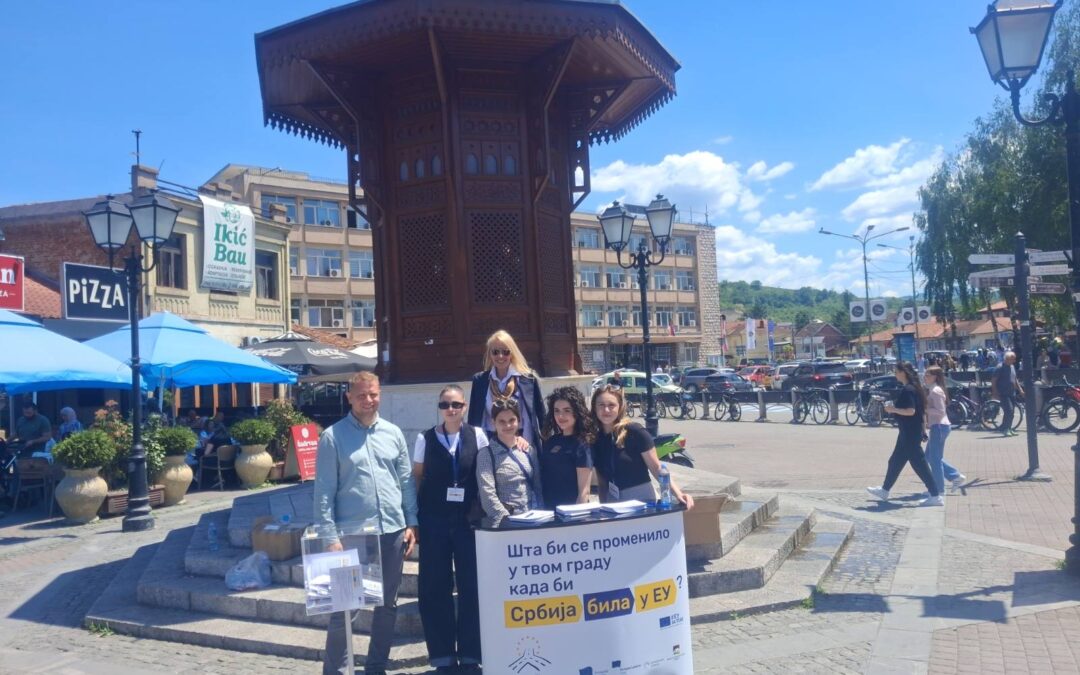
This approach continues through district-level programmes, where cultural formats create shared spaces in everyday environments. Here, coexistence is not presented as an outcome, but tested as a condition, through repeated presence, participation, and the gradual development of trust. The brochure offers an overview of this process and the activities through which it unfolds.
The project “District of Reconciliation” is co-funded by the European Union, implemented with the participation of the European Movement in Serbia and coordinated by the Foundation Novi Sad – European Capital of Culture. The contents are the sole responsibility of the authors and do not necessarily reflect the views of the European Union or the project partners.
You can read the full brochure HERE.